

Loring provides geothermal feasibility and preliminary design assessment services to support building owners and project stakeholders in evaluating ground-source heat pump (GSHP) systems as part of our comprehensive electrification and decarbonization strategies. As owners and design teams seek dependable pathways toward improved energy efficiency, resilience, and carbon reduction, geothermal systems are increasingly recognized as a stable HVAC solution that delivers predictable, year-round performance.
By leveraging the thermal properties of the earth, geothermal heat pump systems can provide efficient heating and cooling largely independent of outdoor air conditions. Loring’s approach integrates advanced energy modeling, coordination with geotechnical specialists, geothermal-specific analysis tools, and lifecycle cost evaluation to help clients determine whether geothermal systems represent a technically and financially viable long-term infrastructure investment for their projects.
Across the U.S., state and local jurisdictions are developing policies, incentives, and screening tools to encourage low-carbon heating and cooling solutions. For example, New York City’s Local Law 6 requires City agencies to use a geothermal screening tool when evaluating retrofit projects for City-owned buildings, ensuring geothermal heating and cooling feasibility is assessed early in the planning process. Similar initiatives in other regions continue to promote geothermal systems as a viable option for institutional, commercial, and campus-scale facilities.
Loring’s geothermal services are applicable to a wide range of building types and project scales, including institutional, campus, healthcare, commercial, and mixed-use developments. Applications include new construction, existing building retrofits, and phased implementation strategies across multi-building sites or portfolios.
Each study begins with an understanding of building programming, occupancy patterns, and operational requirements. Attention is given to buildings with higher heating and cooling demands, extended operating hours, and long-term ownership expectations, where geothermal systems can deliver the greatest lifecycle and decarbonization value.
Loring applies a consistent, data-driven methodology to evaluate geothermal feasibility and support early-stage system planning. This approach is scalable and tailored to the needs of each client while maintaining a high level of technical rigor appropriate for capital planning and decision-making.
Building Energy Modeling and Load Analysis
Whole-building energy modeling forms the foundation of Loring’s geothermal feasibility and preliminary design assessments. “Gray-box” energy models are developed to estimate peak heating and cooling loads and simulate annual energy use. Models incorporate building geometry, envelope characteristics, occupancy schedules, internal equipment loads, and lighting assumptions aligned with applicable energy codes, standards, and green building guidelines.

Energy Modeling Simulation to Estimate Peak Heating and Cooling Loads and Annual Energy Use
A baseline HVAC system is modeled to establish a reference condition, followed by one or more proposed geothermal heat pump system scenarios. This allows for direct comparison of system performance, including annual energy consumption, peak electrical demand, heating and cooling balance, and seasonal operating characteristics. Peak loads extracted from the model are used to inform preliminary geothermal system sizing and bore field criteria.
System Alternatives Evaluation
Loring performs side-by-side evaluations of geothermal heat pump systems and conventional HVAC alternatives, including air-source heat pump systems and traditional water-source heat pump systems. Each option is assessed for energy performance, peak demand implications, operational reliability, and suitability for regional climate conditions. Where appropriate, supplemental or backup heating strategies are evaluated to ensure performance under extreme design conditions.
This comparative analysis provides owners and stakeholders with a clear understanding of system tradeoffs and supports informed decision-making early in the planning process.

Comparison of Geothermal and Air Source Heat Pumps
Geotechnical and Bore Field Analysis
Geotechnical conditions are a critical component of geothermal system feasibility. Loring coordinates with geotechnical consultants and utilizes site-specific subsurface thermal properties to support preliminary ground heat exchanger sizing. Specialized geothermal analysis software, including GLHEPro, is used to evaluate thermal interaction between building loads and the surrounding ground over the anticipated life of the system.

GLHEPro – Temperature vs Depth
Site Integration and Layout Optimization
Available site areas are evaluated to identify feasible locations for geothermal bore field installation. Site constraints such as existing utilities, future development plans, access requirements, and operational considerations are incorporated into the analysis. Preliminary bore field layouts are developed to minimize disruption, maintain flexibility for future site use, and to integrate effectively with overall site planning.
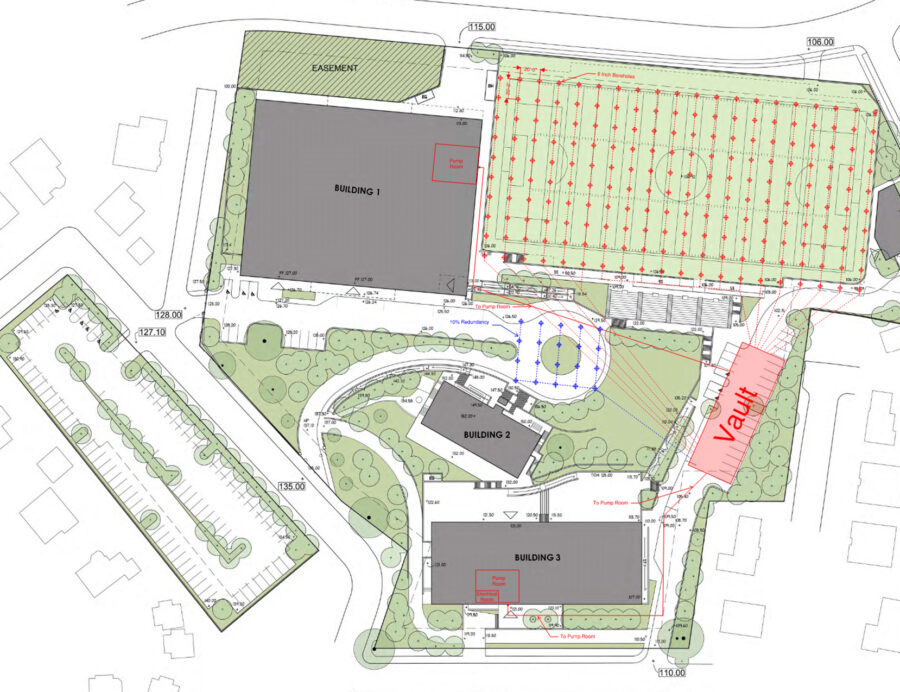
Loring’s geothermal feasibility and preliminary design assessments provide clarity on a project’s ability to meet heating and cooling demands using geothermal systems. Load-based sizing strategies and optimized preliminary bore field layouts support constructability and cost efficiency while enabling reliable, long-term system performance. Compared to conventional HVAC systems, geothermal heat pump systems typically demonstrate improved energy efficiency, reduced peak electrical demand, and greater performance stability over time.
To support owner and stakeholder decision-making, technical analysis is paired with clear and transparent economic evaluation.
Lifecycle Cost Analysis
Lifecycle cost analyses compare long-term operational and maintenance costs associated with geothermal and conventional HVAC system options. Evaluations typically consider multi-decade analysis periods and account for projected energy use, maintenance requirements, and expected system longevity.
Payback and Financial Metrics
First–costs associated with geothermal systems are evaluated against projected energy savings to estimate simple payback and other financial performance metrics, as appropriate. This provides a data-driven framework for understanding long-term value rather than focusing solely on initial capital cost.
Loring’s geothermal feasibility and preliminary design services provide early-stage clarity on both technical and financial viability. Data-driven analysis supports informed capital planning, reduces risk, and enables owners to evaluate geothermal systems as part of broader electrification, decarbonization, and sustainability strategies. Executive-ready deliverables support confident decision-making and next-step planning.
With deep experience in energy master planning, advanced energy modeling, and mechanical systems analysis, Loring supports clients in evaluating geothermal solutions from initial feasibility through implementation support and coordination with design teams.
Geothermal systems are not simply an energy solution; they are a long-term infrastructure investment. Loring helps clients understand both.

Kalpak Karule, PE, CEM, CBCP, CMVP, LEED AP
Principal & Energy Group Leader
Phone: 646-674-6176
Email: KKarule@loringengineers.com

Contact us to learn how we can assist you with
your engineering needs.


