

Fire Protection + Life Safety
Information + Communication + AV Technology
THE INFORMATION AND COMMUNICATION TECHNOLOGY SERVICES GROUP SPECIALIZES IN DESIGN AND MANAGEMENT SERVICES FOR TELECOMMUNICATIONS, AUDIOVISUAL, AND SECURITY SYSTEMS
Loring’s Information and Communication Technology Services Group engineers provide integrated, robust, and reliable design solutions that are essential in today’s technologically demanding and ever-evolving climate. Our team, which includes Registered Communications Distribution Designers (RCDD), Audio-Visual (AV), and Security Certified Designers, specializes in providing design and management services for telecommunication cabling, telephony, data communications, and wireless services. Our experts develop AV, Security, and Information Technology (IT) infrastructure designed to satisfy the requirements of today’s virtual meeting environments, multimedia, security, IP video, and mission-critical systems. These systems are designed with the flexibility to anticipate and accommodate future technologies to maximize the benefit to our clients. Our planning is based on a deep understanding of how the various IT systems relate and interact with the building, and most importantly, with the people occupying them, which is paramount to the success of the installed technology systems. Working with the client at the outset, we consider a host of factors including space and speed requirements, stacking and adjacencies, HVAC and electrical power and emergency needs, furniture integration, cable routing, security, AV system needs, and projected technology systems costs. We then develop a Basis of Design for a Technology Infrastructure Report, which serves as a guide for further development to deliver IT solutions that respond to each Owner’s individual needs.Energy + Sustainability + CFD Modeling
ENERGY & SUSTAINABILITY SERVICES
Loring’s Energy and Sustainability Services Group helps building owners identify and implement opportunities to reduce energy consumption, operating costs, and carbon emissions while optimizing overall building performance.
Our team provides technical guidance that enables clients to make informed decisions regarding energy use, sustainability goals, regulatory compliance, and overall system performance. By combining engineering expertise with advanced modeling and simulation tools, we evaluate both operational and design strategies that improve efficiency, reduce greenhouse gas emissions, and enhance occupant comfort.
Loring’s design engineers integrate strategies that balance first cost, long-term operating costs, maintenance considerations, and potential future energy or carbon penalties. Through life-cycle cost analysis and performance modeling, we evaluate technologies such as solar photovoltaics, geothermal systems, thermal energy storage, combined heat and power (CHP), and other low-carbon solutions to determine their feasibility and value for each project.
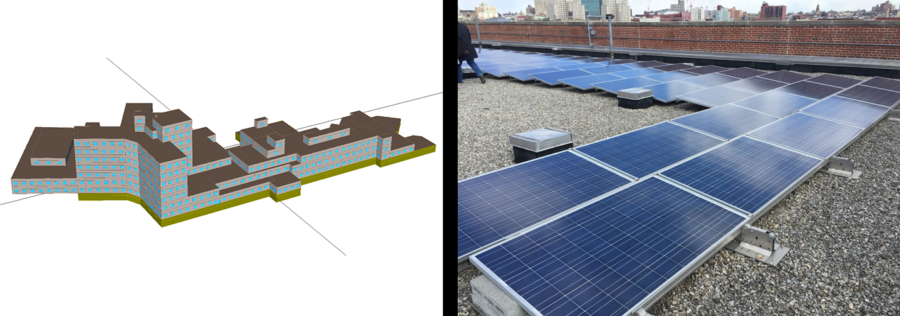 Our team includes Professional Engineers and accredited professionals across multiple disciplines, including Certified Energy Managers, Certified Energy Auditors, Building Energy Assessment Professionals, Certified Building Commissioning Professionals, Distributed Generation Certified Professionals, and LEED Accredited Professionals. Together, this team has performed energy audits, deep energy retrofits, energy master plans, feasibility studies, and retro-commissioning for hundreds of buildings across a wide range of sectors.
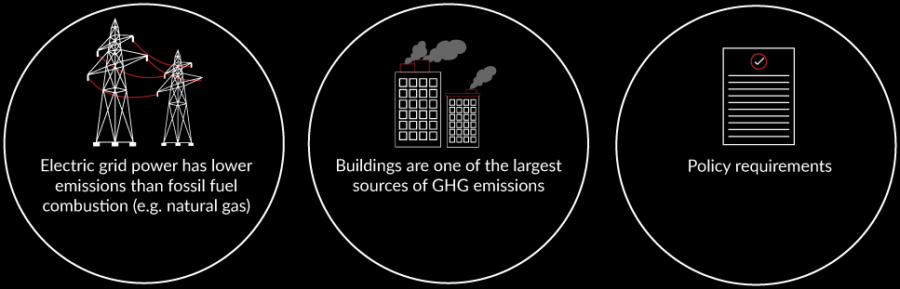
With increasing policy mandates and decarbonization targets at the city, state, and federal levels, building electrification and renewable energy integration are becoming central to long-term infrastructure planning. Loring helps clients navigate these changes by identifying practical, cost-effective pathways to reduce emissions while maintaining reliable and resilient building systems.
Our team includes Professional Engineers and accredited professionals across multiple disciplines, including Certified Energy Managers, Certified Energy Auditors, Building Energy Assessment Professionals, Certified Building Commissioning Professionals, Distributed Generation Certified Professionals, and LEED Accredited Professionals. Together, this team has performed energy audits, deep energy retrofits, energy master plans, feasibility studies, and retro-commissioning for hundreds of buildings across a wide range of sectors.
With increasing policy mandates and decarbonization targets at the city, state, and federal levels, building electrification and renewable energy integration are becoming central to long-term infrastructure planning. Loring helps clients navigate these changes by identifying practical, cost-effective pathways to reduce emissions while maintaining reliable and resilient building systems.
 Loring is a NYSERDA approved FlexTech Consultant, and a registered District of Columbia PACE Clean Energy Contractor.
Explore Loring’s Energy and Sustainability Services brochure here.
COMPUTATIONAL FLUID DYNAMICS (CFD) MODELING
Computational Fluid Dynamics (CFD) modeling complements Loring’s energy and sustainability services by using advanced simulation tools to evaluate airflow, temperature distribution, pollutant dispersion, and overall environmental conditions within and around buildings.
Our CFD studies are performed by licensed mechanical engineers who combine real-world design experience with advanced simulation expertise. Rather than simply generating models, we translate simulation results into actionable engineering recommendations that improve safety, comfort, and energy performance.
Loring is a NYSERDA approved FlexTech Consultant, and a registered District of Columbia PACE Clean Energy Contractor.
Explore Loring’s Energy and Sustainability Services brochure here.
COMPUTATIONAL FLUID DYNAMICS (CFD) MODELING
Computational Fluid Dynamics (CFD) modeling complements Loring’s energy and sustainability services by using advanced simulation tools to evaluate airflow, temperature distribution, pollutant dispersion, and overall environmental conditions within and around buildings.
Our CFD studies are performed by licensed mechanical engineers who combine real-world design experience with advanced simulation expertise. Rather than simply generating models, we translate simulation results into actionable engineering recommendations that improve safety, comfort, and energy performance.
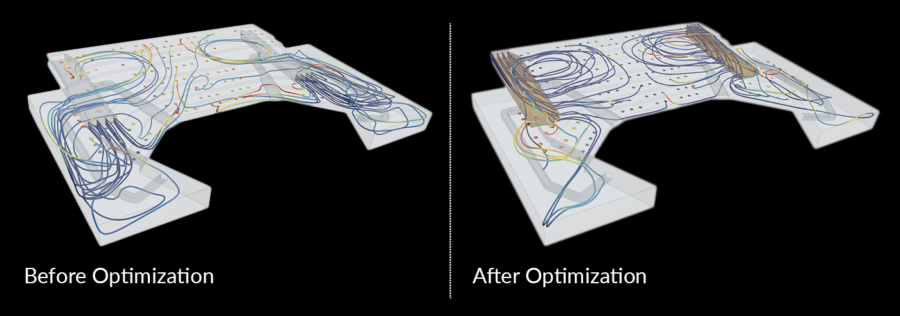 CFD analysis allows project teams to visualize and predict airflow, temperature distribution, pollutant transport, smoke movement, and wind effects in complex environments. This capability enables design teams to identify issues early in the design process and optimize system performance before construction begins.
Typical applications include:
Indoor Airflow and Thermal Comfort Analysis
CFD analysis allows project teams to visualize and predict airflow, temperature distribution, pollutant transport, smoke movement, and wind effects in complex environments. This capability enables design teams to identify issues early in the design process and optimize system performance before construction begins.
Typical applications include:
Indoor Airflow and Thermal Comfort Analysis
Our team includes Professional Engineers and accredited professionals across multiple disciplines, including Certified Energy Managers, Certified Energy Auditors, Building Energy Assessment Professionals, Certified Building Commissioning Professionals, Distributed Generation Certified Professionals, and LEED Accredited Professionals. Together, this team has performed energy audits, deep energy retrofits, energy master plans, feasibility studies, and retro-commissioning for hundreds of buildings across a wide range of sectors.
With increasing policy mandates and decarbonization targets at the city, state, and federal levels, building electrification and renewable energy integration are becoming central to long-term infrastructure planning. Loring helps clients navigate these changes by identifying practical, cost-effective pathways to reduce emissions while maintaining reliable and resilient building systems.
Loring is a NYSERDA approved FlexTech Consultant, and a registered District of Columbia PACE Clean Energy Contractor.
Explore Loring’s Energy and Sustainability Services brochure here.
COMPUTATIONAL FLUID DYNAMICS (CFD) MODELING
Computational Fluid Dynamics (CFD) modeling complements Loring’s energy and sustainability services by using advanced simulation tools to evaluate airflow, temperature distribution, pollutant dispersion, and overall environmental conditions within and around buildings.
Our CFD studies are performed by licensed mechanical engineers who combine real-world design experience with advanced simulation expertise. Rather than simply generating models, we translate simulation results into actionable engineering recommendations that improve safety, comfort, and energy performance.
CFD analysis allows project teams to visualize and predict airflow, temperature distribution, pollutant transport, smoke movement, and wind effects in complex environments. This capability enables design teams to identify issues early in the design process and optimize system performance before construction begins.
Typical applications include:
Indoor Airflow and Thermal Comfort Analysis
- Optimization of HVAC air distribution strategies
- Evaluation of temperature stratification and humidity profiles
- Assessment of natural ventilation and passive airflow strategies
- Simulation of airborne contaminant transport
- Evaluation of ventilation effectiveness in sensitive environments
- Infection control support in healthcare and laboratory facilities
- Modeling of exhaust dispersion and pollutant dilution
- Prevention of exhaust re-entrainment into outdoor air intakes
- Pedestrian wind comfort and safety assessments
- Prediction of smoke movement and stratification during fire events
- Evaluation of smoke control system performance
- Heat transfer analysis for life safety and structural protection